In countering China, the US must not lose its knack for nuanced diplomacy
- America’s ability to provide leadership and stability in a dangerous world depends on its skill in managing complexities
- While it must support allies and resist Chinese aggression, it may lose balance if it believes in black-and-white narrative of virtuous allies and evil Chinese

TOP PICKS
Comment
Beijing’s defence of national security should be open and above board
6 Aug 2020

Comment
Cold War 2.0 is just a distraction
6 Aug 2020

Comment
Under Biden, average Americans will remain at the heart of US trade policy
6 Aug 2020

Comment
New US ‘China scare’ is big on pressure, short on vision
5 Aug 2020

Comment
Time to invest government surplus to boost Hong Kong’s economy
6 Aug 2020

News
Can China succeed in its attempts at vaccine diplomacy?
5 Aug 2020

Comment
Canada should drop Meng Wanzhou case, shaking free of US coattails
5 Aug 2020

Comment
Beirut disaster another reminder on dangers of explosive materials
6 Aug 2020

Comment
How can US-led grouping get China to act fairly in the South China Sea?
4 Aug 2020

Comment
What China’s pivot towards economic self-sufficiency means
5 Aug 2020

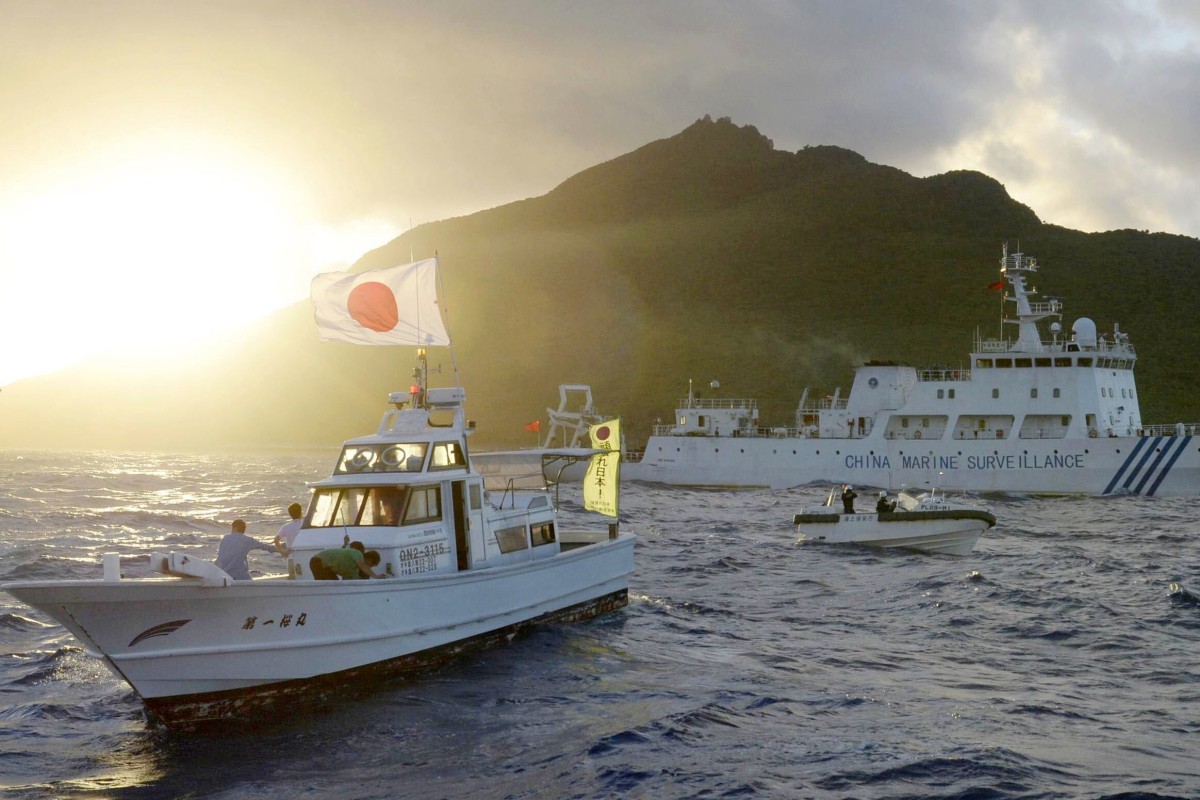
A Chinese maritime surveillance vessel passes near the Senkaku/Diaoyu Islands in the East China Sea in July 2013. Photo: Kyodo
For 10 days in July, a familiar kind of conflict occurred in the Pacific. One Asian country had piled concrete on a tiny rock, then called the rock an island and declared a 200-nautical-mile exclusive economic zone around it.
Another country was conducting freedom of navigation operations inside that zone, declaring that the United Nations Convention on the Law of the Sea does not permit exclusive economic zones around rocks built up into artificial islands.
Familiar – except that the country that had built a rock into an artificial island and declared an illegal exclusive economic zone was Japan. The country conducting freedom of navigation operations (ostensibly a survey) was China.
The rocks in question, Okinotori, which Japan calls its southernmost territory, are way out in the Pacific between Taiwan and Guam, vastly farther from Japan than the South China Sea islands are from China. The Japanese transformation of a minuscule rock there into an artificial island began years ago.
The Japanese gambit on Okinotori provided the precedent for China’s analogous although bigger and
.
The squabble over Okinotori was important news in Japan but did not make the cut in most US media. It does not fit the prevailing narrative, which is that evil China does bad things like building up phoney islands and making illegal claims while the virtuous US and Japan strive to uphold international law.
Much else does not fit the narrative. Under the standards used by The Hague tribunal to
to big areas of exclusion around its holdings in the South China Sea, the Senkakus (Diaoyus to the Chinese) are rocks, not islands, and Japan has no right to claim exclusive zones around them.
The biggest Senkaku/Diaoyu islet is about twice the size of its South China Sea counterparts, but still tiny and, unlike South China Sea rocks Itu Aba (the Taiwan-occupied Taiping Island) and Woody Island (Yongxing Island to Chinese), they are uninhabitable. Yet Japan and the US vigorously denounce Chinese “intrusions” into these areas as aggressive and dangerous.
Japan’s claims on the ocean are based heavily on its insistence that its rocks must be granted all the privileges of islands under international law. Japan denies China’s rocks that privilege, maintaining that The Hague tribunal standards bind China and the Philippines but not Japan.
Likewise, Japan says that rocks under its administration must be treated as its inviolable territory regardless of ambiguous history and legality, whereas it vigorously disputes South Korea’s analogous claim to a group of islets between Japan and South Korea,
, which is under South Korean administration, with a similarly ambiguous historical and legal background.
None of this justifies China’s excesses in the South China Sea. No country has the right to assert sovereignty over that vast expanse of vital international seaway.
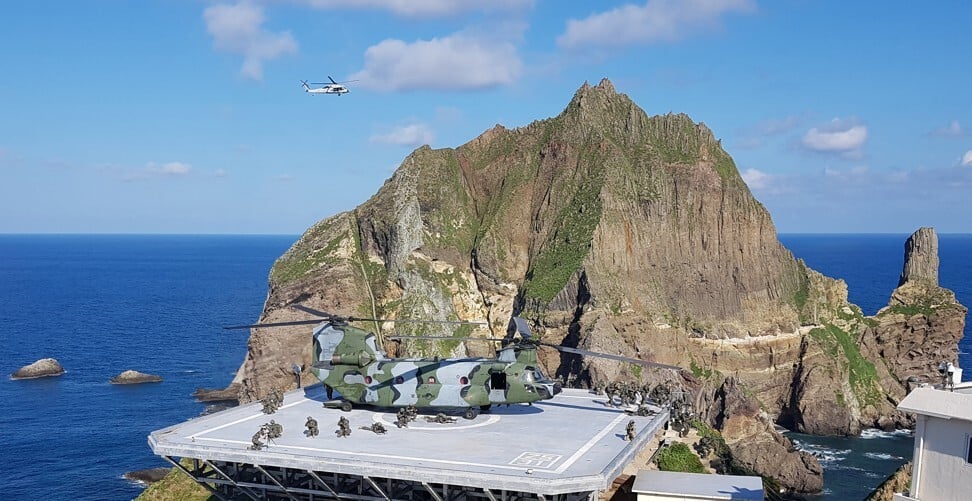
Members of the South Korean Marine Corps take part in a military exercise in Dokdo/Takeshima in August 2019. Photo: South Korean Navy/Yonhap via Reuters
Some of China’s claims are particularly outrageous, most notably its seizure of control over
, far from China and close to Manila, formally claimed as Philippine territory, and the vital food supply for generations of Filipino families.
Beijing’s disregard of hungry families, accurate history, delicate ecology, neighbours’ interests, China’s own voluntary commitments to the UN Convention on the Law of the Sea, and regional stability requires pushback.
Having said that, US failure to acknowledge realities outside the comfortable narrative of virtuous allies and evil Chinese inhibits America’s ability to provide leadership and stability to a dangerous world. In the past, Washington maintained leadership by managing complexity.
When I interviewed the great US ambassador to Korea Philip Habib in 1973, he was in no doubt who our ally was and who our enemy was. But he said: “I have two jobs. One is to prevent the North Koreans from coming south; the other is to prevent the South Koreans from going north.”
US president George W. Bush strongly supported Taiwan, but when then president Chen Shui-bian edged towards formal independence, Bush firmly told him that if Taiwan provoked war with the dragon, it was on its own.
Similarly, Washington was always careful to say that it backed neither Japan’s nor China’s claims to sovereignty over the
“islands”.
But in 2012, when Japan broke its decades-long peace understanding with China and grabbed ownership of the islands, over US objections, Washington abandoned historical balance and treated the rather minimal Chinese response as dangerous aggression.
(Legalistic arguments about the requirements of the US-Japan alliance ignore the loophole in all US alliance agreements: implementation will be based on US domestic processes.)
Like ambassador Habib, the US must never forget who its allies are, especially Japan. It must uphold international law against China. But abandonment of complexity and balance in favour of a Manichean narrative of good and evil accelerates a dangerous vicious circle in the US-China relationship and inhibits future opportunities for negotiated settlements.
A policy justified as supporting the rule of international law is unsustainable if implemented with hypocrisy.
William H. Overholt, senior research fellow at Harvard’s Kennedy School, is author or co-author of nine books, mainly about Asian development and geopolitics, most recently China’s Crisis of Success
https://www.scmp.com/comment/opinion/article/3096155/countering-china-us-must-not-lose-its-knack-nuanced-diplomacy
Did you know that among the world's top five health care markets, China is the only one growing at double digits? Get a comprehensive industry review and insights on Covid-19 induced market shifts with the China Healthcare Report, brought to you by SCMP Research.
for our 50% early bird discount now. You will also receive access to 6 closed-door webinars led by China healthcare’s most influential C-suite executives. Offer Valid until August 10th 2020.

Comments